email - info@lowenergybuild.com Call: 07441 424 875 (UK) / +44 7441 424 875

WUFI in New Build and Retrofit Projects: Why Hygrothermal Modelling Matters
How WUFI helps reduce moisture risk in new build and retrofit projects, including PAS 2035 work.
4/23/20263 min read
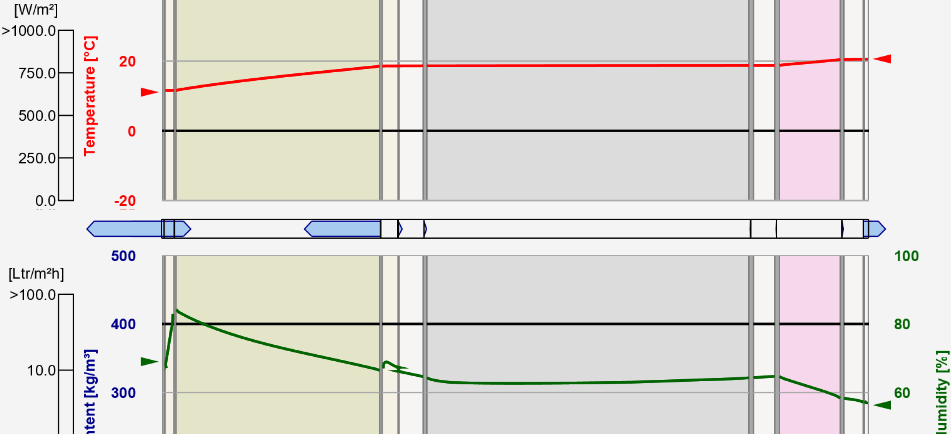
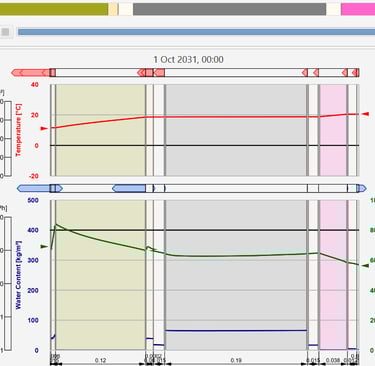
When designing energy-efficient buildings, the focus is often on U-values, insulation thickness and airtightness. It is also about controlling moisture!
A building can meet energy targets on paper and still suffer from condensation, mould or decay if the building fabric is not able to manage moisture safely over time. This is why hygrothermal modelling is such an important part of the design process. WUFI is one of the most important tools for assessing moisture risk in both new build and retrofit projects.
What is WUFI?
WUFI is a hygrothermal simulation tool used to assess how heat and moisture move through building elements over time. Unlike a simple steady-state condensation calculation, WUFI takes into account real climate data, driving rain, solar drying, vapour movement and the moisture properties of materials.
This gives a much more realistic picture of how a wall, roof or floor will behave in the real world. It helps identify whether a proposed construction is likely to remain dry, whether moisture will build up over time, and whether the design could lead to condensation, mould growth or decay.
Why WUFI is important in new build projects
In new build construction, WUFI can be used to check whether wall and roof build-ups are robust, particularly in highly insulated or airtight buildings. As buildings become more energy efficient, the margin for error becomes smaller, and poor detailing can have a bigger impact on long-term performance.
WUFI is especially useful for:
Timber frame construction.
Hybrid wall systems.
Vapour-open or breathable assemblies.
Highly insulated roofs and walls.
Flat & Green Roofs.
For architects, developers and building designers, hygrothermal modelling provides greater confidence that the proposed specification will perform safely over time.
Why WUFI is perhaps even more important in retrofit projects
Retrofit projects are often more complex than new build because they deal with existing construction, unknown materials and hidden moisture risks. Older buildings may already contain defects, historical moisture, poor maintenance or fabric that behaves very differently from modern construction.
When insulation is added during retrofit, the moisture balance of the building can change significantly. This is particularly important in projects involving:
Internal wall insulation.
External wall insulation.
Roof upgrades.
Traditional solid wall buildings.
WUFI can help assess whether the existing building fabric will be able to dry safely after the retrofit, and whether the proposed solution could create condensation or a mould risk in the future.
WUFI and PAS 2035
WUFI is particularly relevant to retrofit projects delivered under PAS 2035, where a whole-house, risk-based approach is required. PAS 2035 places greater emphasis on understanding the existing building before deciding on measures, especially where the risk of moisture problems is higher.
For higher-risk retrofit measures, especially internal wall insulation, hygrothermal modelling can help demonstrate whether the proposed solution is appropriate for the building and whether it is likely to create moisture concerns.
This makes WUFI a valuable tool for retrofit coordinators, architects, consultants and contractors who need to make technically robust decisions and reduce the risk of future defects.
WUFI versus steady-state condensation calculations
Traditional condensation calculations still have a role, but they rely on simplified assumptions and do not fully capture how a construction behaves over time.
WUFI provides a dynamic hygrothermal analysis that considers changing weather conditions, drying potential, rain exposure and material behaviour. This makes it a much better option where the construction is complex, the risk is higher, or the existing building fabric needs careful assessment.
Conclusion
Whether you are working on a new build low-energy project or a deep retrofit, moisture risk should always be considered alongside energy performance. WUFI hygrothermal modelling helps assess whether a design is likely to work safely over time, not just on paper.
For architects, developers and retrofit professionals, this provides greater confidence in the design and helps support more durable, reliable and moisture-safe buildings.
Get in touch
07441 424 875 (UK) / +44 7441 424 875
info@lowenergybuild.com